

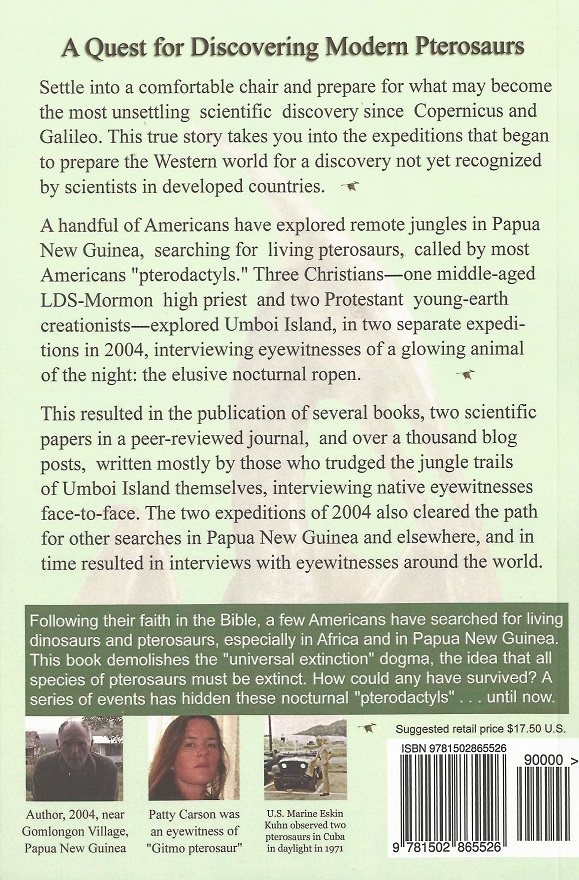
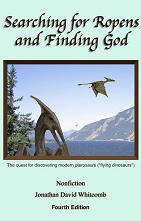
Searching for Ropens
and Finding God
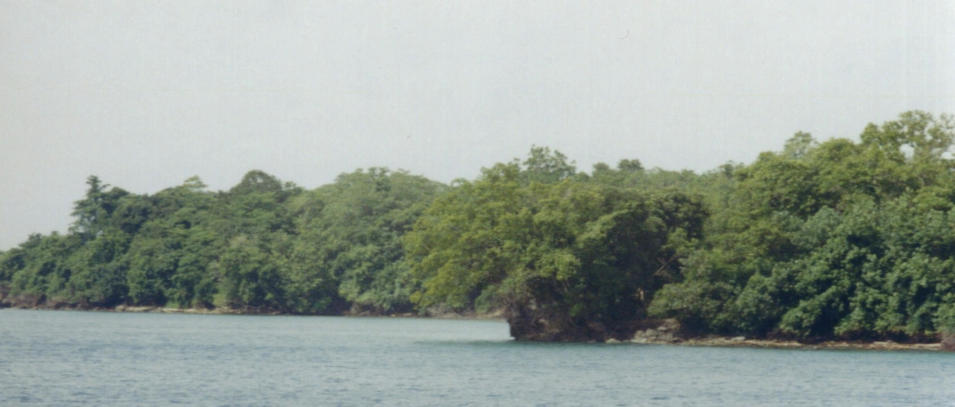
Finschhafen Harbor, Papua New Guinea - photo by Jonathan Whitcomb
A smaller cryptozoology book than Searching
for Ropens and Finding God, nevertheless
highly acclaimed in reviews by readers
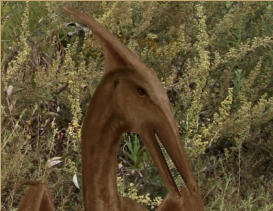
Witnessed in central Arkansas, 2012
(The above sketch is by Richard Dobbs, Junior)
(Please be aware: the interior of the book does not
have color images but standard gray-scale images.)
Four siblings pose for a photo, gazing
at a local tourist attraction. But each
of these four children saw a strange
kind of flying creature, not many
years earlier, at Guantanamo Bay,
Cuba: apparently a long-tailed ropen.
During those sightings, they were not
pretending astonishment: It was real.
“A physicist [Clifford Paiva], who examined
video footage of two strange lights that ex-
plorers think are bioluminescent pterosaurs,
declares that the glow is not from meteors,
lanterns, campfires or an airplane.”
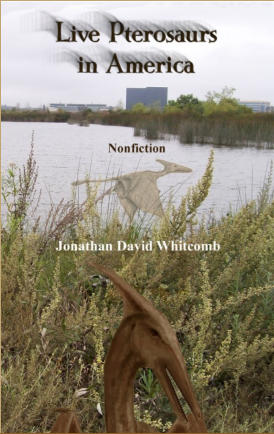
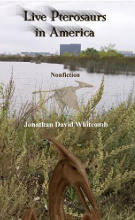
Live Pterosaurs in America, third edition
—a shorter book than Searching for Ropens
and Finding God, easier to finish, yet filled
with many fascinating sightings in the USA
Paperback, 6x9 inches, 360 pages
Published on October 31, 2014
Fourth edition, nonfiction
ISBN: 1502865521
EAN13: 978-1502865526
$17.50 suggested retail price
Cross genre: religion-science, true-life adventure,
human interest, cryptozoology, spiritual
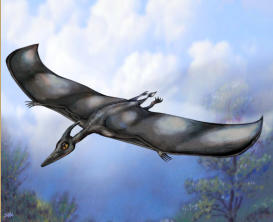
Copyright 2007-2016 Jonathan David Whitcomb
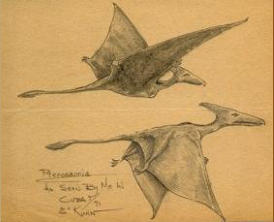
“I was looking in the direction of the ocean when I saw
an incredible sight. It mesmerized me! I am an artist with
sharp eye for detail and was determined to drink in the
visage before me for future recording on paper. . . .
“I saw two pterosaurs . . . flying together at low altitude,
perhaps 100 feet, very close in range from where I was
. . . The rhythm of their large wings was very graceful,
slow, and yet they were flying and not merely gliding . . .”
From page 160 of SFRFG: the words of the eyewitness Eskin C. Kuhn
Please see the new official home page of
Searching for Ropens and Finding God
From readers of the first edition of the book:
“I read the book cover to cover in the first 48 hours after I received it (it was hard to put down).
The author does a great job of laying out the known facts about the Ropen. “I was equally
fascinated with his personal account of summoning up the courage to go on the trip in the
first place. The book was as much . . . about finding the courage within you to do something
extraordinary as it was about a possible cryptozoological event.” (Alex Aguila, Florida)
“I sat up till nearly 4 a.m. reading your book. . . . personally I think you have done a brilliant
job of it. Its full of humor and spirituality. Every page was interesting! Your honesty in the
book really shone through and it was just such good reading. Loved it!” (Penny, Australia)
“Thanks for your valuable book, that’s not only informative (very intelligently written), but
very interesting to read.” (Gizella Szegeczky, California).
Comments from those who read the second edition:
“I bought this book some time ago expecting nothing but the typical, boring cryptozoology
book. However, what I found was that it contains a wealth of INTERESTING information
on a cryptid that until now, I had known relatively little about. Mr. Whitcomb's way of story-
telling was captivating to say the least. His scientific procedures also impressed me.
“Normally, when Creationists study cryptozoology, there are very little facts presented: mostly
just a bunch of reports of ‘sightings’ without going too much into detail. In this book, you
will be presented not only with an entertaining ‘search for a lost animal’ story, but you will
also come across very specific details . . . all the way down to the exact silhouette of the
creature, its diet, size, etc. . . .
“All in all, a very satisfying, captivating read on a little known animal. I'm looking forward
to reading more by this author!” (J. Navarro, May 23, 2011)
“Be prepared to have your eyes opened to the mysteries yet to be discovered in God's awesome
creation. This book is packed full of sightings and details of the amazing and intriguing animal
known as Ropen that is found in Papua New Guinea. . . .
“I would give this book 10 stars if I could! This book should be in every library!!” (Shalee Britton)
“I can hardly put this book down. It is quite astonishing to read of creatures so large that they
can lift a human up into the air or rob a corpse from a new grave. They even glow at night with
bioluminescence.
“It is understandable how eyewitness are sometimes reluctant to tell their stories because of
ridicule they experience - fueled by Western evolutionary superstition. How sad we in the west
are so blinded by wrong assumptions fed to us by the 'scientific' mainstream.
“This book is so refreshing. Jonathan Whitcomb is to be congratulated for giving us a glimpse
of our world denied us by the wildlife 'experts' from western countries.” (S. Lee)
Duane Hodgkinson, WWII veteran
Brief explanation of the third edition of the book, by Whitcomb
This retitled edition is greatly expanded, with a new chapter, “Pterosaurs in the USA,” adding
a hundred pages of sightings and discovery. In addition, sightings from various areas of the planet
are included. And of course the more recent events have been added.
The new title, Searching for Ropens and Finding God, makes it clear that religion clears the
path of our investigation, yet this third edition is more of a call for tolerance for religion. The
first and second editions included lengthy reasoning for belief in the Bible and disbelief in the
General Theory of Evolution. This expanded edition is less preachy, more of a call for mutual
respect, defending the investigative procedures of my associates more than defending many
details about our religious beliefs.
Consider this from the Introduction:
“Yet this is not mainly about religion, not in the usual sense. It’s less likely to take you to church
than into the lives of ordinary persons who have encountered extraordinary flying creatures, and
into the lives of Christians who have risked their health, even their lives, in searching for living
pterosaurs. Our disbelief in the General Theory of Evolution has freed us to search far and near,
and for years, with a firm belief that God’s purposes will prevail.”
With that said, readers will find this book promotes giving credit to God for the life we have in
this wonderful world.
Searching for Ropens and Finding God, fourth edition
From the Introduction:
“We live in a world in which modern Westerners, at least many respectable or respected ones,
have believed all magical dragons to be only legendary and all pterosaurs to be extinct and even
more ancient; also in this world, many natives, whom we had assumed more primitive or less
gifted than us, have believed all dragons to be real and either magical or spiritually gifted. In
some areas, they believe dragons to be both ancient and modern. What if all of us have been
only partially correct? What if flying dragons are not so much ancient as modern, not so much
magical as physically gifted, not so much legendary as real?”
From the first chapter:
“Later I learned that a hungry ropen doesn’t always wait for a funeral. I phoned Carl Baugh,
founder of the Creation Evidence Museum in Glen Rose, Texas, who had visited Papua New
Guinea to investigate the ropen stories. He told me about an old man, crippled with cancer in
about 1995, who was attacked by one of the creatures. In daylight, in a village near the city
of Lae, thirty eyewitnesses saw the creature carry the man into the air, then drop him. This
happened three times before the creature finally carried off the body to eat it. It sounded like
a dragon story but with an eerie feeling of reality. . . . I wrote to Baugh, but I had no idea how
deeply I would be drawn into the mystery.”
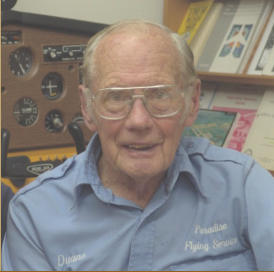
Many years after his service in World War II,
Duane Hodgkinson (now deceased) became
a flight instructor. He remained firm in his
testimony about the giant “pterodactyl” that
he and his army buddy had observed in 1944
in New Guinea, just west of Finschhafen.
The third chapter of Searching for Ropens
and Finding God is devoted to this 1944
sighting in what is now Papua New Guinea.
Please support the research: purchase at least one of
these two cryptozoology books on modern pterosaurs.
Two complementary nonfiction books